
By Matthew Brake
Brian Cronin wrote an interesting article on CBR about six years ago discussing John Byrne’s 1980s reboot of the Superman villain Lex Luthor. Historically depicted as a mad scientist, Byrne updated him for the 80s by reworking him into a corrupt businessman who loved to put his name on every building (regular towers of Babel), an outward sign of the massive ego within.
Even when Byrne was off the book, the similarities between the two men didn’t stop. When Lex Luthor ran for president of the United States in the comics, DC printed an “unauthorized biography” of the character whose book design was reminiscent of Trump’s Art of the Deal (Cronin).
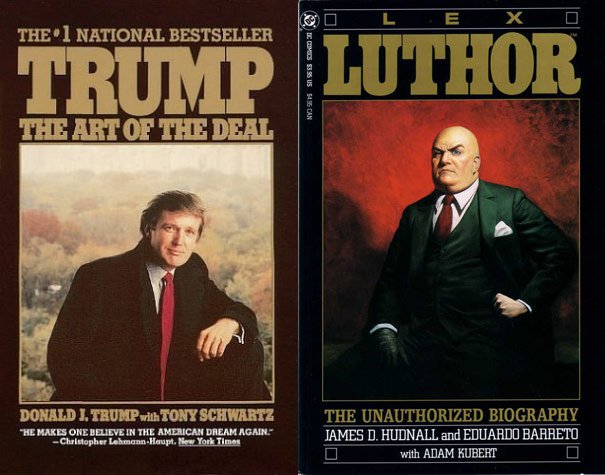
I’ve spent the last few years thinking about the similarity between these two men, the ways they are alike and the ways that they are different, and unfortunately, the similarities outweigh the differences.
Byrne’s own comments shed light on both Lex’s character, as well as Trump’s: “I built the character as a cross between Donald Trump, Ted Turner, Howard Hughes and maybe Satan himself!” (Cronin).
Of the businessmen Byrne mentions, it’s known that all of them have massive egos, but the comparison to Satan is especially noteworthy. One of the traditional characteristics of Satan is unbounded pride.
One sees this reflected in biblical passages that have been interpreted allegorically to refer to Satan. For example, Isaiah 14:12-14 (NRSV) says:
“How you are fallen from heaven, O Day Star, son of Dawn!
How you are cut down to the ground, you who laid the nations low!
You said in your hear, ‘I will ascend to heaven; I will raise my throne above the stars of God…
I will ascend to the tops of the clouds, I will make myself like the Most High.’”
Elsewhere, Ezekiel 28:17, another passage that Christian tradition has come to interpret as referring to Satan, tells a figure called the king of Tyre that “your heart was proud…you corrupted your wisdom for the sake of your splendor.”
This pride caused the kings in these passages to see themselves as unassailable. They were winners, not losers. This is a pride that cannot abide anyone positioning themselves above them, not even God.
In Byrne’s first Lex Luthor story, Man of Steel #4, Lex manipulates events at a party he’s throwing, allowing it to be attacked and telling his security to stand back, all so he can see this new “Superman” he’s been hearing about. Meeting Superman, he tries to buy his services, because he can’t imagine anyone with power in Metropolis not working for him. Not only does Superman turn him down, but Superman is deputized by the city mayor to arrest Lex for intentionally endangering the lives of his party goers. I’m sure Luthor found this “very unfair.”
Here, Lex’s resentment again Superman is stoked. And why? Because unlike everyone else in the city, Superman refuses to go along with Lex’s view of reality, where Luthor is on top and he gets his way with little to no resistance. A petty, narcissistic authoritarian, Lex cannot abide someone who keeps him from getting his own way. From now on, everything Lex does is driven by vindictiveness against Superman. Even his decision to run for president is driven by his resentment against the man from Krypton. The only thing more petty might be if someone ran for president because the current sitting president made a joke about them at the White House Correspondents Dinner (after the sitting president spent years watching the butt of their joke spend years stoking a bunch of racism related to a birth certificate).
Probably the most terrible example of Lex’s pride comes from the era of the Death of Superman in Superman #10 by Dan Jurgens and Brett Breeding when Luthor kills a martial arts instructor because she bested him on the mat. It isn’t quite the same as “You can do anything. Grab ‘em by the pussy. You can do anything,” but it still treats another person as an object of one’s prideful power. Visiting Superman’s tomb later, he tells the Man of Steel’s dead body that, “There wasn’t a man on earth who could stop me from doing whatever I pleased! And if anyone dared interfere, they were given a one-way ticket to hell. That’s the main reason I killed her, you know. That Sasha witch. I throttled the life from her throat with my bare hands just to prove to you that I was king again….and you cant do one blessed thing about it! You’re dead! You are nothing! And I am back on top!”
This is narcissism at its highest levels. Instead of conforming to reality when it doesn’t match your wishes, one schemes and plots and lies and even kills (or perhaps acts negligently, causing others to die) to make reality conform. This is the strategy of the strongman.
Pride can’t understand not using its power to get its own way. It doesn’t understand putting others before itself. This is why, in another one of Byrne’s early stories, Superman #2, Lex is given all of the evidence he needs to prove that Superman is really Clark Kent, but he refuses to believe it. Why? Luthor says, “I know that no man with the power of Superman would ever pretend to be a mere human! Such power is to be constantly exploited. Such power is to be used!!” Serving others. Being meek (power under control). That’s for suckers and losers. Power is to be used to assert one’s own will for one’s own benefit.
For Luthor, the world and the people in it are his playthings. This is illustrated particularly well in the back up story to Byrne’s Superman #9. Luthor goes to a diner 900 miles outside of Metropolis. There he tells a waitress that if she leaves her husband and comes to live with him for a month, he’ll give her one million dollars. He’ll be in his car and wait exactly ten minutes for her answer. While she resists at first, telling Luthor that he “may be used to getting [his] own way in everything,” she does pick up the phone to call her husband to say she’s leaving, only to hang up the receiver. She goes back out to find that Luthor left before the ten minutes was up. As Luthor tells his driver, “[She] will never know what her final choice would have been. And that question will torment her for the rest of her meaningless life!”
Other people don’t matter to Lex Luthor. All that matters is manipulating others to get his way, truth and consequences be damned. If someone gets in his way, his petty narcissism pushes him to lie and ruin the other person. It doesn’t matter if he sends the world to hell, as long as he gets vengeance on his enemies.
If you’re eyes are open, then it has been hard not to read the description on Lex Luthor without making comparisons to Trump’s own behavior. In the exaggerated fiction of a superhero universe, narcissistic pride looks like trying to kill a selfless alien visitor from another planet. In real life, it looks like lying about an election become one’s pride can’t handle reality not going its own way. It doesn’t matter if your own Attorney General or justices you’ve appointed tell you there’s no evidence for fraud, and it doesn’t matter if your lies create social division and upheaval that splinters an already polarized country or drives families apart. What matters is that your pride has been hurt.
There are, of course, differences between Lex Luthor and Trump.
For instance, when Lex ran for president, as detailed in the Superman: President Luthor collection, he had a clean criminal record. One could forgive the American public for voting for someone with a clean criminal record, as opposed to someone whose criminal indictments are known to all.
Lex doesn’t use the racist dog whistles that Trump’s campaign does (well, except against superbeings immigrating from another planet. He doesn’t like them. And he objectifies women as much as Trump does).
Lex Luthor is also a scientific and technological genius, who could actually change the world for the better if not for his narcissism. In Grant Morrison and Frank Quitely’s final issue of All-Star Superman, issue #12, Luthor screams at Superman, “I could have saved the world if it wasn’t for you!” To which Superman replies, “You could have saved the world years ago if it mattered to you, Luthor.”
By contrast, not only is Trump self-serving, but as Bob Woodward noted when he appeared on The Late Show with Stephen Colbert on October 17, 2024 , “He has this idea that he knows things he doesn’t know.”
In his public facing rhetoric, Luthor is also strangely unifying in his tone, not allowing his private grievances to be aired. The picture he paints of America’s future is actually quite hopeful.
But both men are alike in that they are both vile, loathsome men whose chances of being president are too good.
They are men who would rather side with totalitarians than with more benevolent allies. In Trump’s case, he would rather side with someone like Putin, whose own ethnic conflict in Ukraine is reminiscent of Hitler’s attack on Poland (Putin himself made this comparison in his interview with “journalist” Tucker Carlson). Likewise during his own presidency, Lex would rather side with the villain Darkseid (revealed in Jeph Loeb and Ed McGuinness’ Superman/Batman #6), created by Jack Kirby to represent the very totalitarianism that someone like Putin embodies. It might doom his country and the very planet, but who cares as long as his petty pride is vindicated.
I can handle bad policy. I can’t handle a literal supervillain in the White House.
Matthew Brake is an assistant professor of philosophy at Northern Virginia Community College. He is the series editor of the Theology, Religion, and Pop Culture series from Lexington, and the series editor of the Studies in Comics and Religion series from McFarland.
 Pop Culture and Theology
4 Comments Add yours